Transpose PDF Sheet Music
Transpose PDF sheet music to the key you need.
Move the whole score, or write one part for a B-flat, E-flat or F instrument.
For PDFs exported from notation software. Scans and photos aren’t supported.
Ready to upload
Uploading your score
Keep this page open until it’s done.
Checking your PDFs
Your score is uploaded
We’ll email you at when it’s ready, usually within 12 hours.
Your scoresThat didn’t go through
Only you can see your scores
Change the key of Pachelbel’s Canon.
Pick another key, or step up or down by a semitone, then press play to hear it.
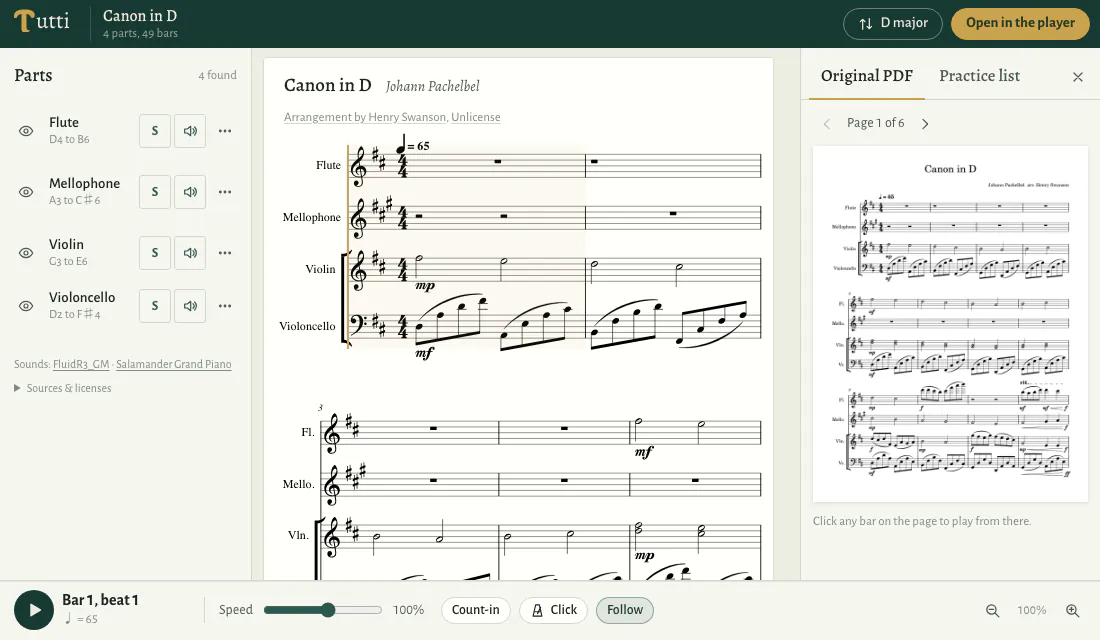
Three ways to land in the right key.
Step by semitone or octave
Move the whole score up or down one semitone at a time, or a whole octave. The original key and the new one show side by side.
Move to a key
Choose from the twelve keys, major or minor to match your score. The new key is spelled with the fewest sharps or flats.
Fit a part to a range
Choose a part and the lowest and highest notes you can play or sing. You get the keys within an octave either way where that part fits.
Writing a part for a transposing instrument.
A transposing instrument reads one note and sounds another. To write its part from a score in concert pitch, move the part up by the interval between the written and the sounding note.
| Instrument | Sounds, compared with the written note | Write the part from concert pitch | Concert C major is written in |
|---|---|---|---|
| Clarinet in B-flat | a major second lower | up a major second | D major |
| Trumpet in B-flat | a major second lower | up a major second | D major |
| Tenor saxophone in B-flat | a major ninth lower | up a major ninth | D major |
| Alto saxophone in E-flat | a major sixth lower | up a major sixth | A major |
| Baritone saxophone in E-flat | an octave and a major sixth lower | up an octave and a major sixth | A major |
| Horn in F | a perfect fifth lower | up a perfect fifth | G major |
| English horn (in F) | a perfect fifth lower | up a perfect fifth | G major |
| Clarinet in A | a minor third lower | up a minor third | E-flat major |
In Tutti, a part on a single staff can be rewritten for Clarinet in B-flat, Trumpet in B-flat, Alto saxophone in E-flat, Tenor saxophone in B-flat or Horn in F from the part’s menu. Its notes are written for that instrument, moved by whole octaves where that keeps them on the staff, and it sounds as it did before.
Concert pitch, when you need to read what sounds.
One switch for the whole score
When your score has clarinets, horns or trumpets, a switch shows their parts at concert pitch: the notes that sound, instead of the notes the players read.
The sound stays the same
Concert pitch changes the notation and what you export. Playback always sounds the notes as they are heard.
A new key for a singer.
Choose the vocal part, enter the singer’s lowest and highest comfortable notes, and pick one of the keys where the line fits. The accompaniment and every other part move with it. Play it through to check, then send the singer a link to the score.
Take the new key with you.
MusicXML
The score in the new key, with concert pitch and rewritten parts as you set them, ready for your notation software.
MIDI
The parts you show, in the new key, for a DAW or a backing track.
The notation in the new key, on paper or as a PDF. Your original PDF pages stay as they were.
Questions about transposing a PDF.
Does transposing change my PDF?
No. Your PDF’s pages stay as they were. The notation, the playback and your exports move to the new key.
Can I transpose just one part?
The key changes for the whole score. To give one player a part in their instrument’s key, rewrite that part for the instrument: it reads in the new key and sounds the same.
Which instruments can a part be rewritten for?
Clarinet in B-flat, Trumpet in B-flat, Alto saxophone in E-flat, Tenor saxophone in B-flat and Horn in F, as well as C instruments in treble or bass clef and viola in alto clef.
Does transposing use my pages?
No. Transposing and playing use no pages. Pages are used only when you unlock them for export, one page each.
Which PDFs can I transpose?
PDFs exported from notation software, such as Sibelius, MuseScore, Dorico or Finale, or printed from it with the music still saved as text and font characters. Scans, photos and handwritten pages are not supported. If we can’t prepare your PDF, we’ll email you to say so. See how to export a PDF from each of them.
More ways to use a PDF score.
- PDF Sheet Music Player
Hear a PDF score and follow it on the page.
- PDF to MIDI
Take a PDF score into your DAW.
- PDF to MusicXML
Open a PDF score in your notation software.